
Video
The telencephalon is the largest part of the brain, derived from the embryonic forebrain (prosencephalon).
The telencephalon is divided into two hemispheres, each controlling the opposite side of the body. It plays a central role in voluntary movement, sensory perception, and complex behaviors.
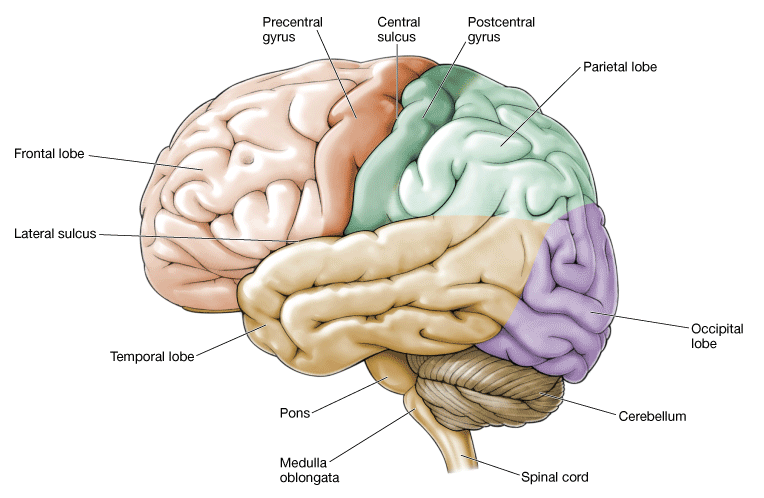
A. Lateral view
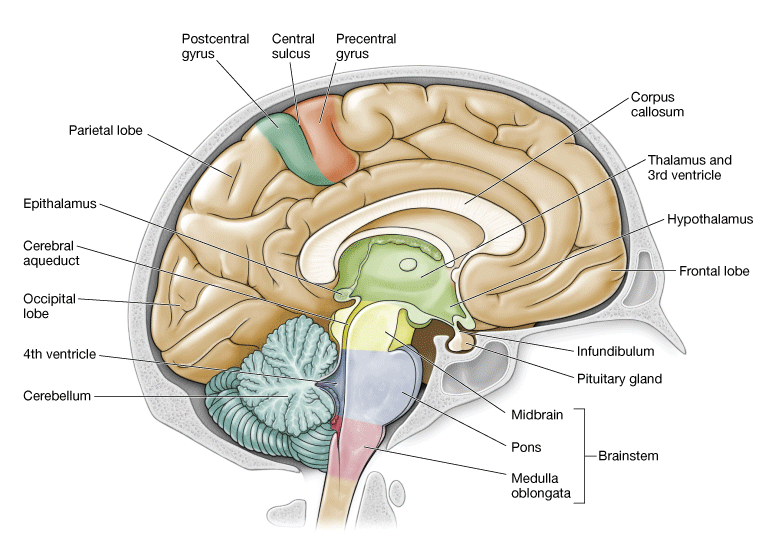
B. Medial view of the sagittal section
Frontal Lobe: reasoning, planning, emotions; , problem solving, and movement (primary motor area within the precentral gyrus) as well as in the motor component of speech (Broca area).
Language is a lateralized brain function and is dominated by centers in the left hemisphere. There are two cortical areas specialized for language (Figure 2-51):
Broca's area is in the frontal lobe, just anterior to the motor cortical areas that control the mouth.
Wernicke's area is in the upper part of the temporal lobe, near the auditory cortex.
The Wernicke-Geschwind model for language has the following elements:
Inputs of spoken or written words arrive from the auditory and visual cortex, respectively, and are relayed to Wernicke's area.
Understanding the meaning of words is achieved by processing in Wernicke's area.
Output from Wernicke's area to Broca's area occurs via a tract called the arcuate fasciculus.
Broca's area generates the commands needed to instruct the neighboring motor cortex to produce the movements of the mouth and tongue needed to speak.
 The Wernicke-Geschwind model is based on clinical findings in patients with defects in understanding or producing words (i.e., aphasia).
Broca's aphasia is characterized by an inability to produce speech or “find a word,” whereas comprehension is generally preserved.
Wernicke's aphasia is characterized by fluent production of speech, but the sentences lack meaning and comprehension of language is poor.
Broca's and Wernicke's areas for language and speech. Arrows indicate the Wernicke-Geschwind model for speech production; information about spoken or written words is conveyed from the auditory and visual cortices respectively to Wernicke's area where language comprehension occurs. Output from Wernicke's area, via the arcuate fasciculus, directs Broca's area to develop a motor program for the generation of speech, which is conveyed to the neighboring motor cortex.
Parietal Lobe: Primary somatosensory(touch, temperature, pain) area within the postcentral postcentral gyrus; orientation, recognition, and visuospatial skills. Iinvolved in carrying out complex movements.
Occipital Lobe: visual processing; contains the primary visual cortex.
Olfactory bulb (processing of smell)
Located deep within the white matter.
Basal ganglia involved in motor control and coordination
Limbic system (including hippocampus and amygdala) is involved in emotion, behavior, learning, and memory)
Video